Delta-Octalactone
-
- Category :
Organic chemicals and Derivatives/Aroma compounds
- CAS NO : 698-76-0
- EC NO : 211-820-5
- Molecular Formula : C8H14O2
- Main Specifications : 99% min
- Synonyms : 5-Hydroxyoctanoic acid lactone;delta-Octalactone;1,5-Octanolide;6-propyltetrahydro-2H-pyran-2-one;Delta Octalactone;
Package: 25kg��,50kg 200kg
Uses : used as food flavor and daily essence
Molecular Structure:
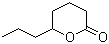
Product description:
What is the chemical of Delta-Octalactone ?
Appearance: Colorless to pale yellow liquid, or described as colorless to slightly yellow clear liquid
Odor: It has a warm coconut like aroma, accompanied by coumarin like bean aroma and creamy fat aroma;
Presenting a sweet, fatty, tropical fruity, and creamy aroma in a 10% propylene glycol solution ;
Assay:99%min by GC ;
IR Identity: conform to standard ;
HNMR: conform to standard ;
carbon spectrum: conform to standard ;
Water by K. F.:0.5% max or as per the customer’s request ;
Loss on drying:0.5% max. or as per the customer’s request ;
Melting point: -14°C;
boiling point: 238 ° C (atmospheric pressure);
==============================================================================
purpose
Main application: used as food flavor and daily essence
Food application: Widely used in tropical fruits, coconut flavored foods, ice cream, beverages, etc., GB 2760-1996 stipulates that it is an allowed edible spice, with a maximum usage of 20 mg/kg
Flavor application: It is suitable for flower fragrance, fruit fragrance (especially tropical fruit), oriental flavor and oak moss essence, with good fragrance fixing effect
Safety certification: FEMA number 3214, assessed as having no safety concerns for use as a flavoring agent at current intake levels
===============================================================================
synthetic route
The synthesis methods of butyrolactone mainly include the following:
Reduction lactonization method: produced by internal esterification of 5-hydroxyoctanoic acid after reduction with NaBH ?
Microbial reduction method: Obtained through microbial reduction of corresponding ketone acids
Alkaline saponification method: Using N-methyl-5-hydroxyoctanamide as raw material, Ba (OH) ? is used for alkaline saponification to obtain



 Search Product