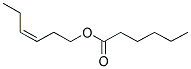
cis-3-Hexenyl caproate
-
- Category :
Organic chemicals and Derivatives/Aroma compounds
- CAS NO : 31501-11-8
- EC NO : 250-661-6
- Molecular Formula : C12H22O2
- Main Specifications : 99% min
- Synonyms : n-Caproic acid cis-3-Hexen-1-yl ester;CIS-HEX-3-ENYL HEXANOATE;CIS-3-HEXENYL HEXANOATE;CIS-3-HEXEN-1-YL N-HEXANOATE;HEXENYL-CIS-3-CAPROATE;HEXENYL-CIS-3-HEXANOATE;FEMA 3403;C3 HEXENYL CAPROATE;(3Z)-hex-3-en-1-yl hexanoate;Cis-3-Hexenyl Caproate;
Package: 25kg��,50kg 200kg
Uses : Food flavor, naturally found in pineapple, apple, pear, strawberry, green tea
Molecular Structure:
Product description:
What is the chemical of cis-3-Hexenyl caproate?
Appearance: Colorless to pale yellow transparent liquid;
Aroma: It has a strong diffusive green fruit fragrance with pear like smell, widely used in fruity essence
Solubility: Almost insoluble in water, but soluble in ethanol, propylene glycol, and most non-volatile oils;
Assay:99%min by GC ;
IR Identity: conform to standard ;
HNMR: conform to standard ;
carbon spectrum: conform to standard ;
Water by K. F.:0.5% max or as per the customer’s request ;
Loss on drying:0.5% max. or as per the customer’s request ;
boiling point: 115 ° C is under reduced pressure (15 mmHg);
===============================================================================
purpose
Food flavor: According to the Chinese national standard GB 2760, folate caproate is a permitted food flavor, which is commonly used to mix essence such as apple, berry, mango, passion fruit (passion fruit), tropical fruit, etc. The addition amount refers to the FEMA standard (such as soft drinks ≤ 0.5 mg/kg, candy, baked goods ≤ 3.0 mg/kg)
Other applications: naturally found in pineapple, apple, pear, strawberry, green tea, orange peel and other animals and plants, also used in tobacco and daily chemical essence
==============================================================================
synthetic route
Main method: Esterification reaction between cis-3-hexenol (CAS: 928-96-1) and n-hexanoic acid (CAS: 142-62-1) catalyzed by strong acidic cation exchange resin to obtain
Reaction equation:
Cis-3-hexenol+n-hexanoic acid → hexanoic acid leaf alcohol ester+water
Yield: Literature reports that the yield can reach about 88%
Industrial production: azeotropic dehydration method is often used to improve conversion rate, and the catalyst can be recycled, which is in line with the trend of green chemistry



 Search Product