Citral
-
- Category :
Organic chemicals and Derivatives/Aroma compounds
- CAS NO : 5392-40-5
- EC NO : 226-394-6
- Molecular Formula : C20H32O2
- Main Specifications : 99% min
- Synonyms : 3,7-Dimethyl-2,6-octadienal;citral (cis+trans);Citralcistrans;Citral Extra. nat.;Citral synthetic;Citral;(2E)-3,7-dimethylocta-2,6-dienal-(2Z)-3,7-dimethylocta-2,6-dienal (1:1);Synthetic Citral;
Package: 25kg����,50kg 200kg
Uses : used to prepare fruit essence such as lemon, citrus, sweet orange
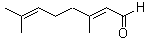
Molecular Structure:
Product description:
What is the chemical of Citral ?
Appearance: Colorless to slightly yellow oily liquid with a strong lemon aroma. It has no optical activity and is stable at room temperature, but is sensitive to air and light, and is prone to isomerization. ;
Assay:99%min by GC ;
IR Identity: conform to standard ;
HNMR: conform to standard ;
carbon spectrum: conform to standard ;
Water by K. F.:0.5% max or as per the customer’s request ;
Loss on drying:0.5% max. or as per the customer’s request ;
boiling point: 228-229 ° C (at 760 mmHg);
=============================================================================
Purpose:
Flavor: According to the Chinese GB 2760-96 standard, citral is a permitted flavor, which is mainly used to prepare fruit essence such as lemon, citrus, sweet orange, apple and strawberry. Specific allowable dosages include 1.70 mg/kg in gummy candies, 43 mg/kg in baked goods, 41 mg/kg in candies, 23 mg/kg in cold drinks, and 9.2 mg/kg in soft drinks.
Daily chemical essence: it is the key ingredient for preparing lemon type, deodorant wood type, cologne, neroli, lavender and other daily essence, and also used for flavoring soap, detergent and other products.
Chemical synthesis: It is a key raw material for the synthesis of important compounds such as ionone, vitamin A, vitamin E, beta carotene, methyl ionone, and menthol.
Other uses: It has bactericidal, insecticidal, and preservative effects, with better preservative ability than phenol, and can be used to mask adverse odors in industrial production. The latest research also suggests that it has the potential to induce plant disease resistance.
=============================================================================
Synthesis route:
Natural extraction: mainly obtained by fractionation or bisulfite method from Litsea seed oil (containing about 70-80% citral) or lemongrass oil. For example, reacting Shan Cangzi oil with sodium bisulfite solution to generate adducts, and then decomposing and extracting with sodium hydroxide for purification.
Chemical synthesis:



 Search Product